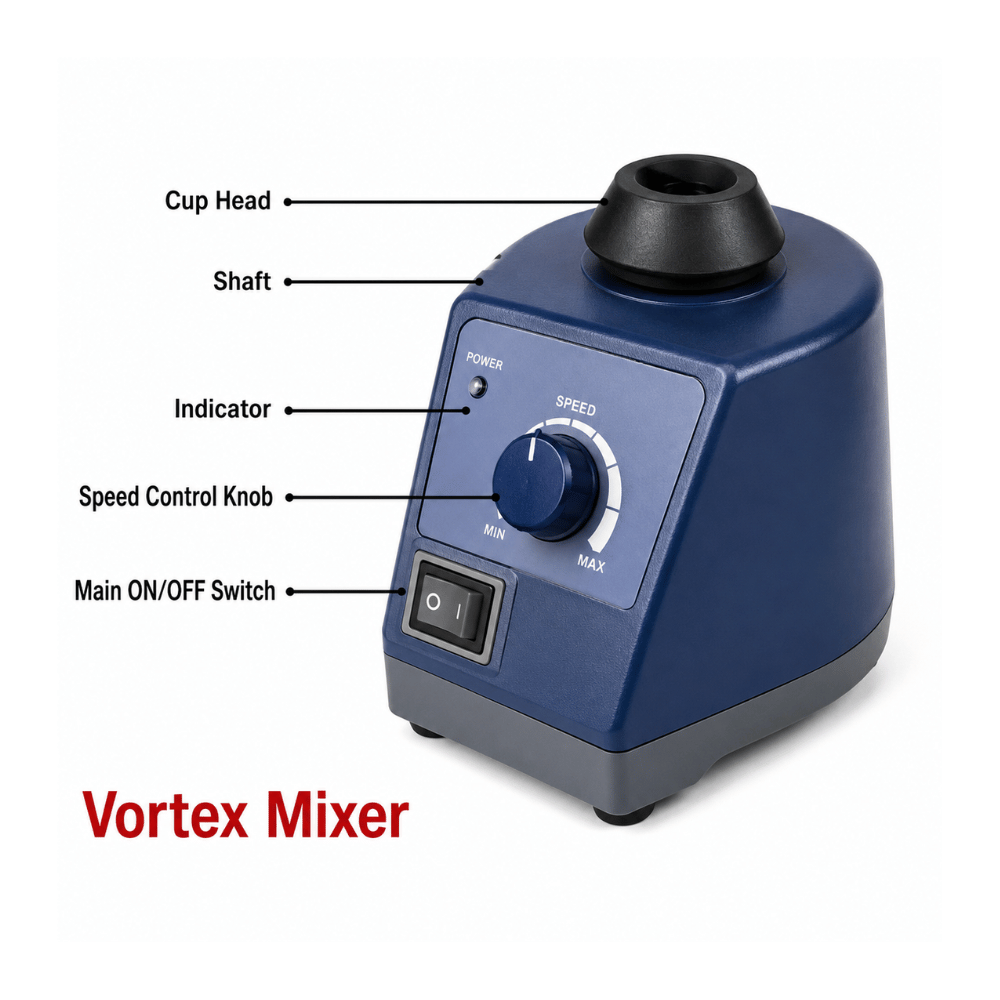
It is useful for rapidly mixing/agitating solution in test tubes. The vibrating neoprene rubber cup accommodates a variety of sizes of test tube/flasks.
Soft, rail, eccentric stroke, mortar driven Neoprene cup imparts vigorous agitation to tubes or small flask held in or against it. Particularly efficient for dislodging sediments from tips of centrifuge tribes. The housing is 150 x 150 mm approx. The vacuum Rubber pads are provided at bottom. Machine supplied with complete with speed control, cord and ON/OFF switch and indicator to work 220V, 1Ph, 50 Hz. AC supply.
A vortex mixer is a simple device used commonly in laboratories to mix small vials of liquid.
Construction of Vortex Mixer is of Stainless steel (Inner & Outer both). It consists of an electric motor with the drive shaft oriented vertically and attached to a cupped rubber piece mounted slightly off-center. As the motor runs the rubber piece oscillates rapidly in a circular motion. When a test tube or other appropriate container is pressed into the rubber cup (or touched to its edge) the motion is transmitted to the liquid inside and a vortex is created. Most vortex mixers have variable speed settings and can be set to run continuously, or to run only when downward pressure is applied to the rubber piece. Vortex mixers are quite commonplace in bioscience laboratories. In cell culture and microbiology laboratories they may be used to suspend cells. In a biochemical or analytical laboratory they may be used to mix the reagents of an assay or to mix an experimental sample and a dilatant.
An alternative to the electric vortex mixer is the “finger vortex” technique in which a vortex is created manually by striking a test tube in a forward and downward motion with one’s finger or thumb. This generally takes longer and often results in inadequate suspension, although it may be suitable in some cases when a vortex mixer is unavailable or the forces involved in overtaxing would damage the sample, but this technique is not recommended when caustic substances are involved. The technique is better suited to accelerate the mixture of solutions which do not require the kinetic energy input needed to create suspensions